You Big Mouth, You!

August 31, 2005

Iraq: Weekly Update 8-31-2005

Filed under: War on Terror, IraqChuck ---

Iraq Weekly Update 8-31-2005 [PDF file]

On August 24, Iraqi Security Forces (ISF) in Baghdad responded to two separate insurgent attacks on police and civilians. The ISF tracked a group who assaulted a Baghdad police station, as well as another who ambushed police and civilian vehicles with rocket-propelled grenades. The ISF killed three and captured one of the attackers.

Al Taakhinewspaper reported that Iraq and Syria have agreed to open flights between the two countries from Baghdad and MosulAirports. The Transportation Ministry clarified that the flights will start onSeptember 15 and will begin flying three times a week. They added that they agreed passing over Iraqi airspace to service other gulf countries and eastern Asian countries.

On August 29, the Mongolian Cabinet approved a fifth rotation oftroops to Iraq. The Mongolian troop contingent is expected to depart for Iraq around September 5.

Daily electricity supplies recovered from the nationwide blackout on August 22 to average 98,000 MWh. Baghdad averaged 8 hours of available power per day. National average was 12 hours per day. Demand has decreased with slight reduction in temperatures.

Phase 3 construction of the NajafTeaching Hospital has begun. Phases 1 and 2 of the hospital reconstruction primarily consisted of restoring essential services and renovating the ground floor outpatient clinics. Phase 3 includes the renovations of the rest of the hospital and is estimated for completion by August 17, 2006. The Ministry of Health is arranging for the repair of the hospital�s MRI and CAT scan machines. Recently two USG contractors visited the hospital to conduct an assessment of the equipment, and the results will be provided to the engineering staff for review.

As of August 24, there were 3,186,905 active cellular subscribers in Iraq. Landline telephone subscribers in Iraq have also increased to 997,675. Prior to Operation Iraqi Freedom, there were approximately 833,000 landline subscribers and no mobile phone subscribers.

A city council in northern Iraq renovated a local radio station through USAID�sIraq Transition Initiative (ITI) support.The city council, in partnership with the U.S. military, identified the establishment of local media as a priority and chose a building site. ITI enabled the development of a local media outlet, an important part of the democratization process and an effective tool for disseminating public information and managing public safety. The initial broadcast range of this radio station reaches 100,000 residents.

August 25, 2005

Iraq: Success Update 8-25-05

Filed under: War on Terror, IraqChuck ---
MNF Iraq
Coalition forces continued to help Iraqi citizens with humanitarian missions and to help train Iraqi security forces to bring stability to the country. Iraqi Soldiers and police worked with local citizens to create a safer environment, and reconstruction projects like new police and fire stations are building the security infrastructure. Other reconstruction projects were able to provide potable water to citizens who otherwise didn’t have access to it.

Coalition forces turned over Camp Zulu in As Suwayrah, Iraq, to the Iraqi Army on Aug. 21. The division’s 3rd Battalion, 3rd Brigade will be permanently housed there. This is the twenty-fourth base to be turned over to the Iraqis, returning the land to the government elected by the people.

The 5th Infantry Battalion of the Bulgarian Army trained Iraqi Army Soldiers in engineering and medical responses, and held a live-fire exercise this week. Medics from the Bulgarian contingent also provided regular assistance to local citizens who needed medical treatment.

Ukrainian military advisers and instructors completed training for the 3rd Battalion of 3rd Infantry Brigade of the Iraqi Army, which will take control from the Ukrainians in the Wassit Province next month. Currently, ISF are manning joint-security checkpoints and conducting patrols with the Ukrainian troops.

A new Salvadoran contingent started its duty in the central-south region of Iraq on Aug. 20. The 380 soldiers, stationed at Al Hillah, will focus on civil-military cooperation , humanitarian assistance and training and advising the ISF. The last rotation of Salvadoran soldiers organized and conducted 85 projects to help Iraqi people, including water supply and sewage systems, education, health care, public security and transportation.

Early this week, workers completed rehabilitation of the domestic water network in Sulaymaniyah. This project is to rehabilitate the potable water system, intended to improve the efficiency of the system there by 20 percent. The Maissa potable water system, a $21,000 project in Mosul to replace a failed water line, was also completed. Also this week; the $27 million water treatment project in Balad Rooz District of Diyala Province will provide 40km of transmission piping and increase the water treatment plant’s capacity to serve 72,000 families, compared to the current capacity of 1,136 families. The $958,000 Al Baida water supply project, which will provide a new water line from the water tower in Al Warka to the community of Al Baida, began on the 22nd.

Approximately 25,000 Iraqis in the Dahuk, Babylon and Wassit Provinces will get treated potable water, thanks to three million dollars released for local projects. The projects will upgrade 15 systems, each including water wells, compact potable water treatment plants and pumps. Completion dates for the 15 projects vary, but are all scheduled to be finished by January of 2006.

Construction has restarted on Sadr City’s $902,000 Al Sadr Fire Station project, after a recent construction collapse while concrete was being placed. The project is scheduled for completion in March of 2006. This three-story structure is almost 10,000 square feet and features five bays; three for ladder trucks and two for SUVs. It includes a dormitory area for 20 firefighters, dining room for 30, commercial-grade kitchenette to feed 40 people, a training room for 20, a locker room, a control room and a chief’s office.

Construction also started on two new police station projects in Fallujah and one in Muthanna Province. Each of the two-story facilities in Fallujah measures more than 35,000 square feet and includes a dorm area for 100 police officers, offices, a holding cell, conference room, kitchenette, armory and covered courtyards.

The Al Khider Police Station construction project in Muthanna Province provided new perimeter walls, replaced roof systems, installed a 528-gallon water tank and piping for potable water storage, and restored electrical and masonry work to the existing police station in Al Khider.

Phase III of the $10 million Najaf Teaching Hospital project began this week with a symbolic �ground-breaking� ceremony on the second floor of the hospital. This phase of the project includes civil, mechanical, electrical and plumbing rehabilitation throughout the facility. The contract also includes a physicians’ residence building, sewer treatment plant, a morgue, storage and garages, and remodeling of the main entrance to the hospital.

Five hundred children in a community west of Al Hillah will start school in a newly renovated school, thanks also to the Coalition forces in the Central-South Division, who finished work on the Abu Gharaq School this week. Other Coalition forces built a playground Aug. 19 for the children of the Tesin Orphanage in Kirkuk. Soldiers built the playground out of discarded auto parts, welding the various parts together. Coalition civil affairs Soldiers spent a busy day with the local leaders, delivering school supplies and then assessing the Musala and Al Sader Primary Schools.

Six school construction and renovation projects were started this week, while two others in Dahuk Province were completed.

Coalition forces rescued a hostage being held by terrorists, captured the kidnappers, and seized weapons from a terrorist safe-house during a cordon-and-search operation Aug. 18 in the Muthana Zayuna district of central Baghdad.

Iraqi security forces were busy as well, discovering two improvised explosive devices while on patrol in Mugdadiyah. An Iraqi explosive ordnance disposal team disarmed the device and removed it for later destruction, making the area safe.

Iraqi Army Soldiers, manning a traffic control point, detained one anti-Iraq force member after searching a vehicle in Mosul and finding a light machine gun and 2,500 rounds of ammunition. Soldiers of the Iraqi Highway Patrol were doing their part, as well, when they discovered an improvised explosive device 29 kilometers northwest of Bayji. An Iraqi EOD team was called in to neutralize the threat and make the area safe for the public. Iraqi Police Service officers in Mosul found two 120mm rounds, which they turned over to an Iraqi EOD team for disposal.

Iraqi Department of Border Enforcement officers and Coalition forces interdicted a small group of smugglers and a large mule train crossing the Syrian border northwest of Tal Afar on Aug. 19 when they discovered five or six men leading over 200 mules carrying fuel pods into Iraq. The smugglers were able to escape back into Syria with some of the mules, but Iraqi and Coalition forces captured 145 of the mules and their fuel loads.

Iraqi citizens continued to augment security forces this week by providing information about insurgent activity. Iraqi Police Service officers on patrol received a tip from a local citizen concerning a suspected weapons cache in the Zohour District of Baghdad. Police uncovered 68 mortar rounds buried in a field. The munitions were transported to Boob Al Sham Police Station. This was the second significant cache find in the same area in two days � 32 mortar rounds were discovered Aug. 21.

Coalition Soldiers seized an opportunity to help Iraqis who had been injured in a head-on traffic accident near Tuz while returning from a combat patrol. The Soldiers provided first aid until an Iraqi ambulance arrived to transport the victims to a hospital.

As part of a Coalition and Iraqi stability-and-support operation, several truckloads of humanitarian assistance rolled out from a forward operating base in southern Baghdad to provide Horajeb residents with basic food items, medical supplies, and recreational items Aug. 17. Toys and soccer balls were donated by friends and family members of the U.S. forces.

The mayor of Muqdadiyah, Coalition forces and Iraqi Soldiers delivered critical medical supplies to the Muqdadiyah Women and Children’s Hospital.

Since the beginning of their mission in Iraq, Ukrainian forces have given medical aid to approximately three thousand Iraqis. Locals from the Wassit Province are treated for routine injuries on the spot, or taken to the medical contingent’s hospital.

Coalition medics helped train the Iraqi Army in combat medical skills this week. Class enrollment tripled since the unit first offered the training. Other forward operating bases throughout the Baghdad area are scheduling combat medic courses to assist in increasing the survivability of the Iraqi Army as they assume responsibility for their own security. In the Combat Leaders Course at the Diyala Regional Training Facility, Coalition Soldiers worked with their Iraqi counterparts to train soldiers from the Iraqi Army’s 5th Division to be better battlefield leaders. Training during the 14-day course builds on the Iraqi soldiers’ basic military knowledge and skills. Most of the instruction is performed by Iraqi cadre, and Coalition Soldiers are more supervisors, observing and instructing when needed. The development of Iraqi Security forces is cultivating a more secure environment for Iraqis, and through help from many Coalition partners and Iraqi citizens, Iraq is progressing toward a stable and prosperous country.

Iraq: Update 8-24-2005

Filed under: War on Terror, IraqChuck ---
Iraq Weekly Update [PDF file]
  • Police Training
    Over the past week, 1,100 trainees began the Police Basic Courseat Baghdad Police College. The Iraqi Police Service graduated 239 police officers from advanced and specialty courses at the AdnanTraining Facility on August 18. The courses consist of Basic Criminal Investigation, Interview and Interrogations, Violent Crime Investigation, Criminal Intelligence, First-Line Supervision, and Election Security.
  • Police Operations
    Iraqi Police Service officers on patrol in Baghdad discovered 32 mortar rounds and 20 rockets in two separate incidents on August 21. In the past several days, Iraqi Police Service officers in Baghdad conducted a variety of operations, including large-scale raids involving over 450 officers. The targeted raids were directed at 40 residences. Police arrested 30 suspected insurgents, three of whom were individually targeted.
  • Electricity
    Average daily electricity service decreased last week (August 16-22) to 83,117 MWh due to a nationwide blackout on August 22. Baghdad averaged 6.7 hours of available power per day. National average was 12 hours per day. Demand reached a new record high on August 17.
  • Potable Water and Water Treatment
    The Project and Contracting Office (PCO) is constructing the Balad Rooz Water Treatment Plant in the Diyala Province. When complete, the water treatment plant will supply 22,000 cubic meters of water per day, enough to provide water to 55,000 Iraqis. PCO has begun work on nearly 70 percent of its planned water treatment plant projects in Iraq, and has completed work on nearly 35 percent of its planned water treatment plant projects.

    USAID restored Najaf�s Wastewater Treatment Plant to full capacity to treat sewage, as well as full residuals treatment, for approximately 141,000 of the city�s 563,000 residents (70 MI/day).

    On August 18, the Army Corps of Engineers (USACE) announced $3 million in contracts have been awarded to bring treated potable water to approximately 25,000 Iraqi citizens in the Dahuk, Babylon and Wassit Governorates. The projects will upgrade 15 systems, each including water wells, compact potable water treatment plants and pumps. The work will also train local operators on site in the technology and maintenance of the water systems. Completion dates for the 15 projects vary, but all are scheduled to be finished by January 2006.


iraq good news

Heroes: Col. James H. Coffman Jr.

Filed under: Military, War on Terror, Iraq, Heroes, WOT HeroesChuck ---

Army News Service

By Sgt. Lorie Jewell

BAGHDAD, Iraq (Army News Service, Aug. 24, 2005) � The Distinguished Service Cross � second only to the Medal of Honor in military decorations � has been awarded to U.S. Army Col. James H. Coffman Jr. for his role in leading Iraqi Special Police Commandos through a 5 �-hour battle against insurgents trying to overrun an Iraqi police station.

Flanked by the commando unit Coffman fought with, U.S. Army Gen. George Casey, commander of Multi-National Forces�Iraq, pinned the cross and eagle medal on Coffman�s body armor during an Aug. 24 ceremony at Adnon Palace in Baghdad�s International Zone. Iraq�s Minister of Interior, Bayan Jabr, and a number of other high-ranking Iraqi and Coalition leaders also attended the ceremony.

�It�s humbling to me, to be in the company of heroes,� Casey said, noting Coffman�s extraordinary heroism in the battle that killed 12 Iraqi commandos and wounded 24. �Such exemplary conduct is a great example to Iraqi commandos and to all American Soldiers and warriors.�

Coffman, 51, is a senior adviser to Iraqi Special Police Commandos with the Multi-National Security Transition Command�Iraq�s Civilian Police Assistance Training Team. He accompanied a commando Quick Reaction Force with the 3rd Battalion, 1st Iraqi Special Police Commando Brigade on Nov. 14, 2004 to help a commando platoon under attack in a Mosul, Iraq police station.

As the QRF approached the station, it was besieged with rocket-propelled grenades, small arms fire and mortar rounds. Coffman and the commandos fought the insurgents for four hours before help arrived. When the initial firefight killed or seriously wounded all but one of the commando officers, Coffman rallied the remaining commandos while trying to radio for assistance, according to his award citation.

�Under heavy fire, he moved from commando to commando, looking each in the eye and using hand and arm signals to demonstrate what he wanted done,� the citation said.

When an enemy round shattered his left shooting hand, damaging his M4 rifle in the process, Coffman bandaged it and continued fighting with AK-47 rifles he collected from commando casualties until each ran out of ammunition. He also passed out ammunition to the uninjured commandos with the help of the remaining commando officer; when all that remained were loose rounds, Coffman held magazines between his legs and loaded the rounds with his good hand.

When a second commando unit arrived four hours after the fight began, Coffman led them to his position and continued to fight, refusing to be evacuated for treatment until the battle was over. Not long after the commando reinforcements arrived, air support and a Stryker Brigade Quick Reaction Force were on hand to assist to assist in the battle.

Coffman supervised the evacuation of injured commandos and led another group of commandos to the police station to make contact with the Iraqi Police inside. Once the additional air and ground support elements began attacking buildings the enemy forces were hiding in, Coffman went back to his initial position to check on the injured commandos and then agreed to be evacuated for treatment. Twenty-five insurgents were killed and dozens injured.

�Col. Coffman, the blood you shed will never be forgotten,� said Jabr, the Interior Minister. �We, the forces of the (Ministry of Interior) and the (Ministry of Defense) will continue to fight until we defeat terrorism. Right will always defeat wrong.�

In remarks during the ceremony, Coffman praised the commandos for their service and commitment to defending freedom in Iraq. He also said he viewed the ceremony as a tribute to the Iraqi and Coalition forces that have fought, bled and died together.

�Third battalion, I am truly, truly honored to stand here with you today and remember your courage and bravery last November and in all the days since then,� Coffman said, facing the commando formations. �It has been an honor to fight with you.�

Jabr and Iraqi Maj. Gen. Adnon Thebit, commander of the Special Police Forces, each presented Coffman with medallions.

Prior to the ceremony, Coffman said surgery repaired the shattered bones in his hand but it still isn�t back to 100 percent. In the months he�s had to reflect on the battle, Coffman said his focus continues to be on the courage and exemplary performance of the Iraqi commandos he fought with.

�I�m very proud of them, and more importantly, they�re proud of themselves,� Coffman said. �The next day, they were back out on patrol � after suffering 30 to 50 percent casualties. That�s pretty amazing. I�m not sure American units would do that. That says something about their resilience and their ability to maintain morale. They certainly mourned their losses, but they got back into the fight right away. I don�t think you can ask much more of people than that.�

After nearly two years in Iraq, Coffman is preparing to return home in early September. He�ll return to a Pentagon job he held prior to deploying to Iraq in December 2003, in the Office of the Assistant Secretary of Defense for Special Operations and Low Intensity Conflict.

After celebrating two wedding anniversaries in Iraq, Coffman is looking forward to returning to his wife of 21 years, Patricia White, and their two grown daughters.

Coffman was able to call his wife from the medical aid station before he was evacuated to tell her what happened, and that he was okay. When he learned he would be awarded the DSC � which came as a surprise � Coffman said there was some debate about whether the ceremony should be held here or at home, where his family could attend. He opted to have it done with the men he fought with.

�In my mind, its more for the Iraqis,� he said.

Coffman doesn�t see himself as a big hero, just a Soldier who did what he had to do to keep himself and his men alive. He believes there are plenty of heroic deeds going on in Iraq � particularly in the military and special police training teams � that go unrecognized.

�There are equal acts out there. This one just got written up,� Coffman said. �I would like to see more people get written up.�

Coffman may downplay his actions, but those who work with him on the commando adviser team describe him as a passionate, tough, and no-nonsense warrior.

�At first, I thought he was crazy,� laughed U.S. Army Sgt. 1st Class Carl Paris, who arrived to the team shortly after the battle. He recalled Coffman greeting him with a large bandaged hand, saying �Hey, guess what, kid,� and then giving him a blow-by-blow description of the fight.

�I have nothing but admiration for him,� Paris said. �He is the example for me being here. A lot of people talk the talk, but he walks the walk. He has a real Soldier�s mentality � cut through the B.S. and get the mission done, no matter what it takes.�

U.S. Army Staff Sgt. Tlaloc Cutroneo feels honored to have been able to serve with Coffman and appreciates the trust Coffman placed with him.

�He has allowed me to be privy to major Iraqi developments and security solutions,� Cutroneo said. �I have sat in on meetings as his battle buddy, not as merely a subordinate. To be referred to as his battle buddy means quite a bit.�

Coffman enlisted in the Army in 1972 in Great Barrington, Mass., where he grew up. The tangible benefits � learning a skill and college tuition � drew him into the service. But gaining an understanding of what being a Soldier means kept him in uniform for more than 30 years.

�The idea of selfless service and patriotism takes over,� Coffman said. �I like that.�

Coffman has a Bachelor of Science degree in Chinese Area Studies from the United States Military Academy at West Point, N.Y. and a Master of Science degree in National Security Affairs from the Naval Postgraduate School at Monterey, Calif. He was also a U.S. Army Fellow at the Fletcher School of Law and Diplomacy, Tufts University in Medford, Mass., and attended the Boston University Overseas Program for Master of Science in International Relations in Vicenza, Italy.

His military career has taken him from Fort Bragg, N.C.; Tampa, Fla. and Washington, D.C. to more far-flung locations like Vicenza, Korea and Gelnhausen, Germany. Along with the Distinguished Service Cross, Coffman�s other awards include the Bronze Star, Defense Meritorious Service Medal, Meritorious Service Medal with four oak leaf clusters, Joint Service Commendation Medal with two oak leaf clusters, the Combat Infantryman Badge, Expert Infantryman Badge, and Special Forces and Ranger Tabs.

Coffman will have to retire in three years, but he figures he still has one more overseas tour in him. He isn�t sure it will be in Iraq, though.

�If asked, I would find it hard to say no,� Coffman said. �I have a lot of respect for a lot of the Iraqis. They have a tough time ahead of them.�

Coffman doesn�t believe democracy can be fast-tracked here. The United States had to work through several years of contentious issues � including a Civil War � before it enjoyed a stable democratic government.

�It�s easy when you�ve had a couple centuries of experience with democracy to overlook the difficulties in getting that,� Coffman said. �I can�t think of a nobler endeavor than to help 28 million people achieve it.�


More Pics

Filed under: PG, PhotosChuck Simmins ---

Pretty girl

August 23, 2005

Musings: My Head Is a Tin Can

Filed under: Original writing, MusingsChuck ---

I had a truly frightening dream last night. Ed Asner made an appearance. As a psycotic bum, but still… Who dreams about Ed Asner?

Ten hours at the base today, no calls. Penfield and Brighton rans their asses off. Ten hours tomorrow and ten on Thursday to fill out my time for the month. Oh, yeah, and some on Saturday at a special event.

Freakin’ Waste Management wants $250 for their smallest dumpster. There go my thoughts of hoeing out the household junk in one fell swoop.

Every now and then, every now and then, mind you, I get the suspicion that bigger folks in the blogosphere read me and steal my ideas. I’m just saying…

And I still think somebody at CentCom or above read my suggestion duing the Iraq Liberation to drop guided concrete bombs to minimize damage.

There’s this show on TV called “Crappy Jobs” or something. The guy goes and learns all sorts of less desirable jobs. The advert today showed him learning to be a farrier, a blacksmith. As the guy is shoeing the horse, it’s taking a dump over his left shoulder.

I hate having to say “OK, everyone count your fingers.”

Hey, good news for a change. We got a CPR save in the Corps this past week. That makes 3 in the eight years I’ve been with East Rochester. The medic asked me about the pin we give, and if it held numbers for future saves. I laughed, and told him to enjoy the pin. Saves are few and far between. One of the three happened at a Christmas party for a local cardio-thoracic department. Hey, if you’re going to have the big one, do it at a dinner full of cardiac surgeons and nurses. The fellow didn’t dare die.

We also give a pin for delivering a baby. Those are few and far between, too, here in the burbs. Most moms are prepared, unlike downtown.

What? Me, cynical?

August 22, 2005

Epidemic: Flu Pandemic

In the twentieth century we had three influenza pandemics, 1918-19, 1957-58 and 1968-69. They are known as the Spanish Flu, the Asian Flu and the Hong Kong Flu, respectively. We know a lot about the last two pandemics, and some things about the first. The Spanish Flu swept the planet right on the edge of modern medicine and modern public health. It’s frustrating to not have the data that we would have had just a couple of decades later, but that’s the way it happened.

The Spanish Flu is everyone’s nightmare. The CDC says:

… caused the highest number of known influenza deaths: more than 500,000 people died in the United States, and up to 50 million people may have died worldwide. Many people died within the first few days after infection, and others died of complications later. Nearly half of those who died were young, healthy adults. Influenza A (H1N1) viruses still circulate today after being introduced again into the human population in the 1970s.
HHS says:
The Spanish Influenza pandemic is the catastrophe against which all modern pandemics are measured. It is estimated that approximately 20 to 40 percent of the worldwide population became ill and that over 20 million people died. Between September 1918 and April 1919, approximately 500,000 deaths from the flu occurred in the U.S. alone. Many people died from this very quickly. Some people who felt well in the morning became sick by noon, and were dead by nightfall. Those who did not succumb to the disease within the first few days often died of complications from the flu (such as pneumonia) caused by bacteria.

One of the most unusual aspects of the Spanish flu was its ability to kill young adults. The reasons for this remain uncertain. With the Spanish flu, mortality rates were high among healthy adults as well as the usual high-risk groups. The attack rate and mortality was highest among adults 20 to 50 years old. The severity of that virus has not been seen again.

Obviously, a similar outbreak today would kill well over a million in the United States and hundreds of millions worldwide.

The problem is that we don’t have enough data to project what the next influenza pandemic will be like, a catastrophe like the Spanish Flu or far milder like the Hong Kong Flu. And, we don’t have enough data to even model how a catastrophic flu epidemic would play out, because 1919 is not 2005. A lot of things have changed in the medical and public health fields.

I don’t believe that it will be possible to head off and isolate a catastrophic flu before it becomes a pandemic. Most flu strains appear first in Asia, and many of the countries involved are Communist dictatorships with known problems being truthful. The Spanish flu is somewhat unique in that it appears first in Army camps in Kansas, though it is reasonable to assume that it originated in Asia as well. Not enough data, mind you.

So, boom! A virulent flu outbreak in Asia, and from there moving worldwide with the rapidity of modern life. The Spanish flu was said to go from onset to death in as little as a few hours. Imagine a 747 on autopilot, cruising the Great Circle route from Tokyo to New York City with all aboard ill, and many dead. Sounds like a Crichton novel made in to a Sci Fi Channel movie.

The development of a flu vaccine takes months. Currently, a committee of experts makes their best guess as to the makeup of the next year’s flu strains, and a suggested mix is created. The manufacturers then go to work to grow the virii and prepare from them the vaccine. If all goes well, the guessing is correct, and the vaccine prep goes smoothly and your flu shot is ready in November. If things go wrong, the flu you are exposed to is not one of the variants in the vaccine, or the process of vaccine creation goes badly awry.

Here’s what the CDC says about the yearly shot:

The ability of flu vaccine to protect a person depends on the age and health status of the person getting the vaccine, and the similarity or “match” between the virus strains in the vaccine and those in circulation. Testing has shown that both the flu shot and the nasal-spray vaccine are effective at preventing the flu.

As for problems in manufacturing, and actual effectiveness, an ABC story from October 2004 states:
Only two pharmaceutical companies make flu vaccine for the U.S. market. The vaccine shortage erupted Oct. 5 when regulators shut Chiron Corp.’s labs in Liverpool, England, cutting the expected U.S. supply by 48 million doses, or nearly half. “This is our biggest nightmare come true,” said Noreen Nicol, chief clinical officer at the National Jewish Medical and Research Center in Denver, which received only about half of the 2,000 doses of flu vaccine it ordered.
The University of Maryland Medical Center says:
According to the American Lung Association, an influenza vaccination is about 70 percent effective in preventing influenza, or reducing its severity, and is considered safe.

However, vaccine effectiveness varies from year to year, depending upon the degree of similarity between the influenza virus strains included in the vaccine and the strain or strains that circulate during the influenza season. Vaccine strains must be chosen 9 to 10 months before the influenza season, and sometimes mutations occur in the circulating strains of viruses between the time vaccine strains are chosen and the next influenza season. These mutations sometimes reduce the ability of the vaccine-induced-antibody to inhibit the newly mutated virus, thereby reducing vaccine effectiveness.

Vaccine effectiveness also varies from one person to another, depending on factors such as age and overall health.


The ability to produce a safe and effective vaccine for a flu pandemic is limited. Right now the avian flu that has been circulating in East Asia since 1997 is most experts’ favorite for the next pandemic. As of yet it has not been proven that H5N1 is communicable from human to human. There are vaccines under study, but… should H5N1 become the next pandemic, will vaccines made from the older, non-contagious version, be useful?

How deadly would a pandemic be?

One measure would be overall deaths. A pandemic in a world of 6.5 billion people will kill vastly more than it did in 1919’s world of 1.8 billion. That is an unarguable fact, and tragic in the extreme, but it says nothing about your individual chances of contracting a pandemic influenza or dying from it.

What are your chances? It is estimated that 20-30% of the population of the planet caught the Spanish Flu. Of that number, about 2% died from it. Those aren’t squeaky clean numbers but close. Most people in a typical year die from infections related to being weakened by the flu and not the flu itself. Still, a normal mortality rate is about 0.1%. Spanish Flu killed at a rate of 2.5%. [CITE]

As a contrast:

SARS SMALLPOX MARBURG
9.6% 30% 85%

OK, so your individual chances of dying from an influenza pandemic are small. If you’re in good health, don’t live in Third World conditions and all that. What scares people about the Spanish Flu is the unusually high number of people in the 20-40 age group who got the disease and who died from it. This is the opposite of any normal influenza outbreak. Obviously something was different then, and the data is so poor that we cannot know what. I have seen speculation that this age group had a previous exposure to an influenza that somehow turned “off” their immune system to the Spanish Flu. I won’t even try to guess, but I will say that in the 86 years since it has not happened again.

The initial feeling about both SARS and the current avian flu was that too many people in the 20-40 age group were getting it, and a red flag went up.

For SARS, it turned out that 21% of the cases were in health care workers, normally falling into this age range, and were due to improper use of universal precautions. Most of the SARS cases also occurred in rural China, where health care and overall health are not as good as they are in other parts of the world.

The cases of avian flu in humans are also occurring in parts of the world where health and health care aren’t the best. The age group contracting this disease is the age group primarily involved with the raising, slaughtering, preparing and cooking of poultry. And that, to this date, is how you catch avain flu. Proper food handling hygiene alone would reduce the number of cases from this disease.

How do we do our best to prepare for the next influenza pandemic? Beats me! Oh, we can stock up on the Tamiflu anti-viral drugs, and try to impose some sort of reporting mechanism on China. We can impose a planetary dictatorship controlling all transportation and medicine… oh, no we can’t.

Realisticly, we can’t do much. Four billion plus people are on their own. We do not have the resources nor the political will, and neither do they. Using the lost Third World to raise money is just sick. No amount of money nor willpower will get a safe and effective vaccine into Darfur nor Aceh nor a host of other places where humans are more intent on killing each other than on saving each other. In places like Nigeria, where polio escaped to travel around the world because of the bigotry of a few Islamic clerics, vaccination seems unlikely to succeed. In Angola, the life expectancy is around 40. How much work will you see there to combat a pandemic flu when people are dying of far more mundane things every day? Where will you obtain the trucks, helicopters and planes to transport health care workers and vaccines safely to the remotest spots on Earth? All the West can do is what it normally does. Prepare itself, and do what little it can for its neighbors.

August 19, 2005

Cats: Bow Before Me!

Filed under: CatsChuck ---

arthur

Arthur, holding down the microwave, in his Goa’uld form.

August 18, 2005

Epidemics: Bird Flu Vaccine

Hey, they made a “bird flu” vaccine for humans! Hooray! Oh, wait… there’s a problem here.

Influenza H5N1 has not yet been demonstrated to be contagious between humans. For all practical purposes, every human who has caught the disease did it from handling, cleaning, cooking, eating infected chickens, or were in intimate contact with areas where those activities occurred. Babies caught it because mom had dirty hands or was carrying them while cooking, etc.

There is little to suggest that any vaccine developed against the current virus would be effective against a pandemic, human to human spread virus. It’ll be a different virus. Duh!

The panicy warnings continue. I saw an article that suggested that a flu pandemic would cause a severe economic collapse. Well, it didn’t in the three pandemics we know about. Public health professionals, if they are professional, will be honest and admit we know a lot about flu pandemics. We’ve had two in the last 50 years. We don’t know enough about pandemics to predict them, but we have enough experience with them to predict their effects.

Drawing conclusions based on the Spanish Flu pandemic of 1919 alone is laughable at best, and fraudulent at worst. Medical care, including infection control measures, has progressed far beyond those of that pandemic. People are generally healthier in the West, and thus less vulnerable to the infection turning life-threatening.

It happens with every potential biological threat, however. Anthrax was presumed to be far deadlier than it turned out to be, because a hundred years ago it was. Smallpox is presumed to be a massive threat based on epidemics in third world nations decades ago.

You cannot spend taxpayer money on threat assessments based on poor and unrelated data. When it all is said and done, it’s about money. Money to study the threat. Money to research a vaccine. Money to purchase vaccine, testing equipment, infection control materials, new desks, nifty computers, hookers in Geneva, and God alone knows what else. Remember swine flu, the flu pandemic that never happened? Too bad for those folks who had reactions to the vaccine, huh? We knew better, we really did. But it’s easier to use panic to obtain money than to use solid science.

Tsunami: Donations and Status

Filed under: Charity, Tsunami relief, Stingy ListChuck ---

I’m no longer working on the Stingy List, but I did want to point out that tsunami charity continues worldwide.

Gulf Times
BRITISH Airways together with Ramada Hotel and Doha Golf Club has raised QR180,000 for Southeast Asia�s tsunami-stricken children. The money was raised at an auction gala dinner organised during a celebrity amateur golf tournament, with international celebrities from the UK and individual contributors from Qatar participating.

At an awards ceremony held at the British Airways office recently, representatives of British Airways, Ramada Hotel and Doha Golf Club presented a cheque for the amount to Omar Shehadeh, Unicef Gulf area office representative, a spokesman for British Airways said in a release.

Rory Black, British Airways commercial manager for Qatar and Bahrain, said the donation will help make a difference in the lives of children still faced with the dire consequences of the December 2004 Indian Ocean tsunami, which killed over 240,000 people.

Earlier this year, British Airways donated �1mn to the tsunami disaster relief fund. Half the donation was passed on to Unicef, and the other half was spent on supply-carrying cargo services and flights to the stricken region, the official said.

Indonesia Relief
Kuntoro Mangkusubroto, Head of Aceh and Nias Rehabilitation and Reconstruction Agency (BRR), announced that Indonesia has received $4.1 billion out of $7 billion that has been pledged to rebuild tsunami devastated areas in Aceh and Nias. Including Rp 8.3 billion from Indonesian national budget.

‘’In the first three months of our (BRR) works, there are $4.1 billion of fund already available to be spent for Aceh and Nias reconstruction,'’ said Kuntoro, after a meeting with Indonesian Vice President Jusuf Kalla in Jakarta.

The fund will be used for various project in Aceh and Nias including construction of Meulaboh port by Singapore government and Singapore Red Cross. Also construction of Ulee Lheue port by Australia government. The Ulee Lheue port will be upgraded from only ferry port to become cargo port.

The fund will also finance construction of road connecting Banda Aceh and Meulaboh. US government provides $245 million, and Japanese government provides additional support of $48 million.

Reuters Alert Net
Former U.S. Presidents George H.W. Bush and William Clinton named the American Refugee Committee�s (ARC) Fishing Boat Project as the first tsunami relief project to receive funding with private money raised through the Bush-Clinton Fund.

The Presidents� $1 million contribution will replace fishing boats in Thailand and provide equipment and support to fishermen, many of whom lost nearly everything in the tsunami. The former Presidents wanted to fund the project because of its economic impact and ability to spur job creation.

The two former Presidents visited ARC�s Fishing Boat Project in Nam Khem, Thailand, on February 19 of this year as part of their tour of tsunami-affected areas. The Fishing Boat Project is the only tsunami relief project they visited while in Thailand.

Indonesia Relief
The CHF International announced donation of $50,000 from Alanis Morissette to empower economic revitalization projects in Aceh, including repairing fishing boats and provide small seed capital to street vendors.

‘’We’re delighted to be partnering with Alanis Morissette in our efforts to restore the economic situation of those affected by last year’s tragic tsunamis,'’ said John Chromy, CHF International’s Vice President on Wednesday.

‘’The support of high-profile individuals like Alanis Morissette is extremely helpful for sustaining public awareness about the long-term economic recovery efforts that will be needed for years to come.'’

Alanis Morissette’s $50,000 donation will be channeled to a local community-based organization in Indonesia’s Aceh province, Udeb Saree Lhok Seudu, to undertake several important economic revitalization projects that will provide local community members with the resources they need to get back on their feet.

August 17, 2005

Musings: Drip, Drip, Drip Leaking Brains

Filed under: Original writing, MusingsChuck ---

Able Danger: Well, it’s like this. Hindsight is beautiful. The facts are that neither the Clinton nor the Bush administration has covered itself in glory with anti-terrorism activities. Hoepfully we’re learning from our mistakes and doing better.

Madonna: Get right back on that horse, or you never will.

Cindy Sheehan: She’s not saying anything she wasn’t the day before Casey died. It’s not grief, that’s just an excuse. She’s a lefty loon, and has been for years.

OK, so I get an e-mail yesterday from a fellow who grew up with the lovely wife and her older brother. Older brother and this guy were buddies. Told the wife and she busted out laughing. Seems brother and my writer made some choke cherry wine when they were about twelve, got loaded and puked rather spectacularily. Funny stuff for the younger sister.

It’s tough to retain your dignity with younger sisters.

Every woman who read the above said to themselves “Dumb shits!” Every guy said “Choke cherry wine? Let’s make some!”

Gonna go do something in the sunshine.

August 14, 2005

Heroes: Heroes Week at Big Mouth

Filed under: Military, War on Terror, Heroes, WOT HeroesChuck ---

WAR HEROES WEEK

This is going to be WAR HEROES WEEK on this blog.

From August 7 through August 14, I will feature stories about the men and women defending America in the War on Terror. Some will be new. Some are already found on my web site American Heroes. All posts for this week will appear below this one.

Sgt. John E. Place Capt. Kellie McCoy Sgt. Willie L. Copeland III
Staff Sgt. Serena Maren Di Virgilio Lance Cpl. Thomas Adametz Hospitalman Luis E. Fonseca Jr.
Sgt. Benny Alicea Capt. Jason E. Smith Rick Rescorla
Staff Sgt. Michael W. Schafer Major Mark Mitchell Senior Airman James Munn
Cpl Danny S. Santos Sgt. Sam Pennock Pvt. Teresa Broadwell
Capt. Brent L. Morel Pfc. Christopher Fernandez 1st Sgt. Michael Storm

Terrorism: the 9/11 Tapes

I listened to a few. I read some of the transcripts. I caught part of a NY Times special on the events of that day. I stopped.

The guilt I feel for not being there is real. The pain of not being able to help. The pride in the men and women who ran toward the fires. The gut-wrenching fear of it happening again.

The goodness that is America is reflected in that day. Everytime we lose the opportunity to remember, we lose a chance to reafirm that this is what America is all about. Old Media hides the film from that day from us, because if we remembered, if we saw again what happened, we could not be led by the fools and evil ones who try to shape our lives today. If we saw, every day, the murders that happened on September 11, 2001, Cindy Sheehan would be a nothing. Michael Moore would be a nothing. All of the cowards and cheats that would lead America away from its values and its traditions would be nothing.

I have moved on, but I will not forget. Too many lived and died as true Americans that day for me to forget. My life must continue, in part as a memorial to their memories, to the things that they died for. Someday, each of us will have a hundred flights of stairs to climb. I will be ready.

Heroes: In Summary

Yesterday was too hectic to post, and I believe I’ve made my point, anyway. There is a lot of information about a lot of American heroes out there. The Old Media has just failed to print it.

All of the men and women that I have featured in the last week have been recognized as worthy of a medal by the military. The folks I’ve featured in my American Heroes page are heroes. But I suspect that not one of them would claim that title. There’s the issue with the Old Media. The people who brag about their medals, like John Kerry, get the press. Those who serve, who are modest about themselves, are ignored. Modesty is not a virtue honored by Old Media.

The first name on my web site of American Heroes is Peter Ganci. It’s also the only name that I have not posted about on my blog. I don’t feel I have the right. Others have, those who knew him, and the honor they give him is far more than I could. Pete Ganci led his men and women into the mouth of the monster on September 11, and far too many died, murdered by our enemies. They were heroes, running toward the disaster. Old Media has forgotten Peter Ganci and his men. Hell, they’ve only remember Alvin York and Audie Murphy in order to take a slap at the current administration. Otherwise, those two brave men would have remained in the dusty archives of Old Media.

If you want to know where the heroes of the War on Terror are, check the military web sites first. I’ll do my best to keep spreading the word, too. But remember, heroes don’t brag so you have to go looking for them. And, sadly, they die far too young and far too soon, so that you won’t have to.

Medicine: Overseas Resource

Filed under: Medicine, Sex, Odd NewsChuck ---

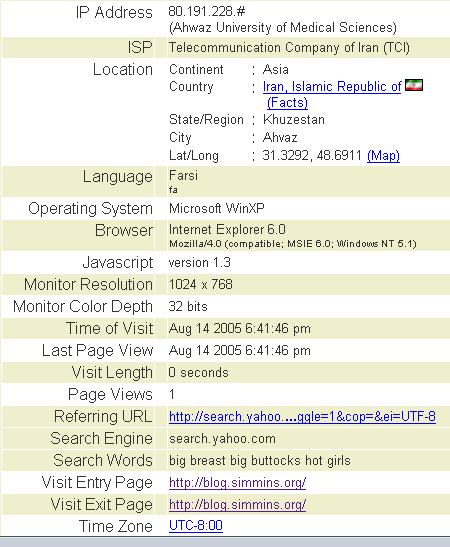
I’ve very glad to see that I’m a research resource for medical students overseas. Those looking for “big breast big buttocks hot girl”, I mean.

Next Page »