Pics: No Longer a Dark Angel

Come back to television, Jessica. Please! It’s so drab without you.
Come back to television, Jessica. Please! It’s so drab without you.
First, the original story, then the details. You will be amazed. These folks done good.
CentcomAt approximately noon on March 20, 26 terrorists were killed, seven wounded, and one captured when they attacked a coalition force convoy on the outskirts of Baghdad in the Salman Pak area. Seven soldiers were injured during the attack. A U.S. military convoy and its security element from the 617 Military Police Company was patrolling when the convoy was ambushed by approximately 40 � 50 terrorists with rocket propelled grenades and small arms fire. The convoy became disabled and the 617 MP�s maneuvered to flank the terrorists. Apache air support was called in but didn�t participate in the engagement. The Apache remained in the area to provide additional support if needed. |
APThe Kentucky National Guardsmen were outnumbered and under heavy gunfire when they counterattacked Iraqi insurgents who ambushed a coalition convoy southeast of Baghdad. A 30-minute firefight ensued on a Sunday morning, pitting 10 guardsmen against dozens of insurgents. When the shooting ended, 26 guerrillas lay dead and another was mortally wounded, while six others were wounded and another was captured unharmed. The guardsmen didn’t go unscathed. Three members of the military police unit were wounded and later transported for medical treatment in Germany, where they are recovering. |
UPDATE: Silver Star for Sgt Hester. Gongs all round for the entire unit.
Defend AmericaMARINE CORPS BASE CAMP LEJEUNE, N.C., Dec. 22, 2004 � In the nation�s times of trouble, the Marines have always rushed to the call of duty. But for one radio technician with the 2nd Marine Division�s 2nd Battalion, 2nd Marine Regiment, who hails from Medina, Ohio � that call for duty brought him a bigger fight than he had ever imagined. |
Featured in 
DefenseLINKBy Sgt. Stephen D’Alessio, USMC |
Featured in
I am not musical. I rarely post about anything involving music. But, I am a speculator. I speculate about a lot of things. I speculate about earworms.
An earworm is a song that you cannot get out of your mind. You find yourself humming it, or singing random verses, until your friends beat you unconscious or you put your head into the oven.
The why and what of earworms:
While I am speculating, I believe I can suggest that most earworms are pop music. An advertising jingle or a television theme song. I suspect that there are few operatic earworms. I could be wrong.
Earworms aren’t the entire song most of the time, though you can catch a nasty version that requires you to replay the entire song in your head. The theme to Gilligan’s Island comes to mind. Or the Oscar Meyer Bologna jingle.
I think a song with a beat, a rhythm, and some simple words makes the ideal earworm. It’s brain filler, elevator music to pass the time between brain processing.
Or it’s subliminal programming to get us all to believe that Paris Hilton really has talent.
Now, I’ll leave you with a few of my recent earworms: theme from Rawhide, chorus to Nothing Like a Dame from South Pacific, chorus to the Marty Robbins song El Paso City, theme from Gilligan’s Island, Oscar Meyer’s Bologna jingle, and the always popular All the Gold in California.
I’ve blogged about this several times, back when Massachusetts did its thing with gay marriage. Yo! Conservatives! I’m talking to you. Yes, you. Equal rights means equal rights. As long as you have government in the marriage business, equal rights means equal rights.
The mess that these court decisions are making will last for years. A court decision doesn’t rewrite the thousands of laws, regulations and forms that exist with the statement or assumption within them that marriage involves a man and a woman. It will be a holy mess, and a goodly number of well-meaning yet ill advised gay couples will be hurt by this.
There is no basis in law to refuse governmental recognition of marriage to gay couples. Or to polygamous couples. Or to adult siblings. Sorry.
The solution is to take marriage away from government and put it back in the Church where it belongs. Let government arbitrate contracts, not commitments.
I have discovered my ideal retirement job. No, not as a nipple makeup artist for Las Vegas shows. Here in downtown Rochester, the city employs a guy to drive what can best be described as a “sidewalk zamboni”. It’s designed to sweep the sidewalk, and wash it at the same time. So, this guy rides around downtown all day, at 2 mph, dodging pedestrians and poles. In the sunny weather, it has to be very relaxing. So, that’s what I want from my retirement.
The other day I was describing PG’s accomplishments to someone, and we both commented that she had done far more than we did at her age. It caused me to reflect that my goal in college appears to have been to kill as many brain cells as possible with beer. It was a goal that I accomplished. I was uncomfortable being young. I’m so much more suited to being 50. That’s a good thing, right?
So these dufusses did not realize they were in the “no fly” zone? What? They weren’t looking out a window? They’re too dumb to be allowed to fly. Yank their tickets.
You know, it looks like they’ll let any old dumb fuck post on the Huffington blog. Perhaps I should try.
What really happened between Paris and Nicole? Hmmmm? What could one nasty girl possibly do to piss off another nasty girl?And is anyone surprised that Chappelle is in the loony bin? Anyone? He’s funny as hell, but way too manic to be totally sane. But… why, oh, why South Africa?
China subsidizes energy costs, and importation costs for its citizens. If energy and raw materials costs are kept artificially low, China can export low cost goods.
Canada.com
China’s exports surged 30.8 per cent in February from the same period a year earlier for a monthly trade surplus of $4.6 billion US, the government said Thursday.It was the 10th straight month of trade surpluses for China, though the February figure was smaller than January’s $6.5 billion, due in part to a suspension of business over the weeklong Lunar New Year holiday. Exports in February grew to $44.5 billion, while imports fell by five per cent to $39.9 billion, the Commerce Ministry said.
China’s trade surplus last year hit a six-year high of $32 billion.
The United States complains China gives its exporters an unfair advantage with hidden subsidies and by keeping the country’s currency artificially weak. China said it will eventually let its currency trade freely but has given no timetable.
Xinhua
Chinese products might swamp the global steel market if the country failed to rein in excess growth in its steel sector, U.S. Steel said. “While forecasts point to continued economic growth and steel demand in China, the China factor could easily reverse just as unexpectedly and quickly as it did for the better,” John Surma, chief executive of the third-largest steel maker in the United States, told the CRU World Steel Conference in Luxembourg on Tuesday.Surma said current Chinese steel capacity exceeded 300 million tons, having more than doubled since 2000, and that China was a net exporter of long and other products in the second half of last year. “If China does not rein in excess growth in private (steel) industry…If China becomes a substantial net exporter on a continuous basis, rather than an importer, the excess steel production could be poured into the market barely in balance…barely in the balance on the strong end of the business cycle, and oversupplied.”
He also referred to new export-destined capacity being developed in such markets as India and Brazil. “If global steel demand does not keep pace with capacity increases � usually a sure sign of subsidised expansion � these developments carry the potential to tip the scale of supply and demand back to oversupply and lead us back to the same position we stood in four years ago.� Surma warned against �non-market forces� deciding on capacity increases rather than having market forces fixing a balance between supply and demand.
The chairwoman of China�s Shanghai Baosteel Group, Xie Qihua, told the conference steel imports into China had fallen for the first time in six years, while exports had risen last year, but that the trend was also due to Chinese steel prices being on average 30 percent below world levels last year. �It might be possible that the steel import negative growth will continue but it is still too early to declare that China has transformed from net importer to net exporter,� she told the conference via an interpreter.
China in 2002 became the world�s largest producer, importer and consumer of steel, and Xie said that the potential for further capacity increases was far from peaking, given the country�s rather low accumulated steel consumption and consumption per capita. China�s domestic steel industry was developing and production was expanding, although there were constraints on the resources side, as well as environmental considerations.
�Chinese steel companies are optimizing the product mix…but the segmented state of the industry does not contribute to the market�s effectiveness� she said. She also said foreign investment in China bringing along new technology to the sector, was always welcome.
Read this story carefully. Certain analysts want you to believe that China, and other Asian countries, are bailing out of the dollar in their foreign currency reserves. Not so.
Forbes
China cut the share of its foreign reserves held in U.S. dollar assets last year, suggesting that the United States might no longer be able to rely on Asia to finance growing deficits, investment bank Lehman Brothers said in a report this week.China’s has the world’s second-largest foreign currency reserves after Japan, with the equivalent of nearly US$610 billion (euro 470 billion) at the end of 2004. That rose by US$209.9 billion (euro 161.5 billion) last year, driven in part by a surging trade surplus.
Even as the reserves grew, the share of dollar assets held by China’s central bank fell to 76 percent, down from 82 percent in 2003, Lehman Brothers said.
The bank “is slowly diversifying its FX (foreign-exchange) reserves away from U.S. dollars,” said the report, written by London-based analyst Shruti Sood.
The Chinese government won’t disclose the composition of its foreign reserves, but acknowledges that most are in U.S. Treasury bills and other dollar assets.
What’s been going on is, as the reserves grow, China is buying a greater amount of Euros than it did before. It’s not selling dollars; in fact it’s still buying dollars. It’s just buying more Euros than it did.
No panic. No disaster.
HUH?
Since when was spending beyond your means the fault of your bank or your credit card company? They’re in the business of lending money. You promised to pay back the money they loaned you. Everyone who values individual responsibility and ethics ought to agree with that.
Sure, shit happens. You ought to be able to declare bankruptcy, in extremis, not every few years.
Yahoo
The proposed anti-secession law, read out for the first time before the ceremonial National People’s Congress, doesn’t say what specific actions might invite a Chinese attack.“If possibilities for a peaceful reunification should be completely exhausted, the state shall employ nonpeaceful means and other necessary measures to protect China’s sovereignty and territorial integrity,” Wang Zhaoguo, deputy chairman of the NPC’s Standing Committee, told the nearly 3,000 legislators gathered in the Great Hall of the People. [snip]
China and Taiwan have no official ties and most direct travel and shipping between the two sides is banned. But Taiwanese companies have invested more than $100 billion in the mainland and the two sides carry on thriving indirect trade.
Until recently, China’s military was thought to be incapable of carrying out an invasion across the 100-mile-wide Taiwan Strait. But Beijing has spent billions of dollars buying Russian-made submarines, destroyers and other high-tech weapons to extend the reach of the 2.5 million-member People’s Liberation Army.
Chinese leaders have appealed in recent months for Taiwan to return to talks on unification. But they insist that Taiwanese leaders first declare that the two sides are “one China” � a condition that Chen has rejected.
In an apparent attempt to calm Taiwanese public anxiety, Wang said the law promises that Chinese military forces would try to avoid harming Taiwenese civilians. He said the rights of Taiwanese on China’s mainland also would be protected.
Reuters
China’s forests and plantations will provide less than half of the country’s expected total industrial wood demand by 2010, according to a new WWF report titled “China’s Wood Market, Trade and the Environment” that was released on Tuesday.While China has worked to protect what’s left of its own forests, its efforts have resulted in an increase in imports from countries where illegal logging is rife, the WWF said. China is now one of the major destinations for illegally harvested wood, with more than half of the country’s timber imports coming from countries such as Russia, Malaysia and Indonesia, where illegal logging is a major problem.
China is the second-largest market for industrial timber, pulp and paper in the world, behind the United States. Americans consume 17 times more wood per capita than the Chinese, but China is soon tipped to become the world’s largest wood market.
THANK YOU!


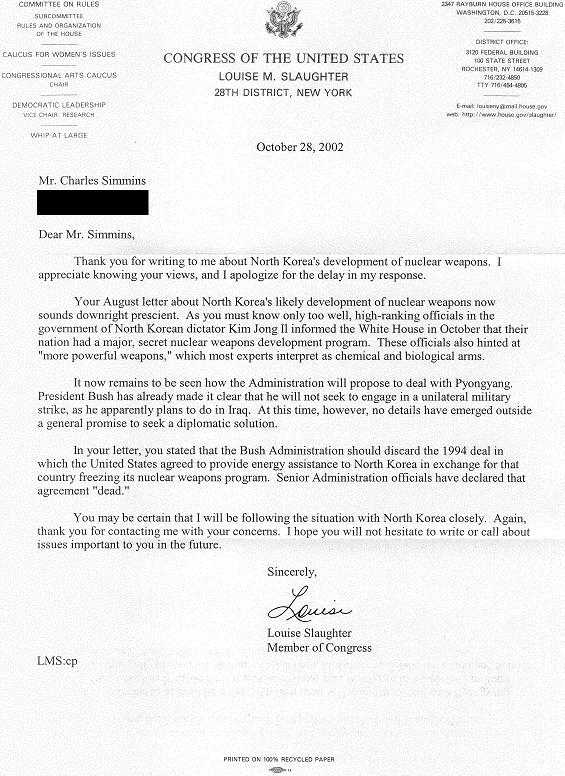
"downright prescient"
Congresswoman Louise Slaughter
"stoical"
BBC
"squirreled away"
Reuters

CENTRAL COMMAND
News from the War on Terror